
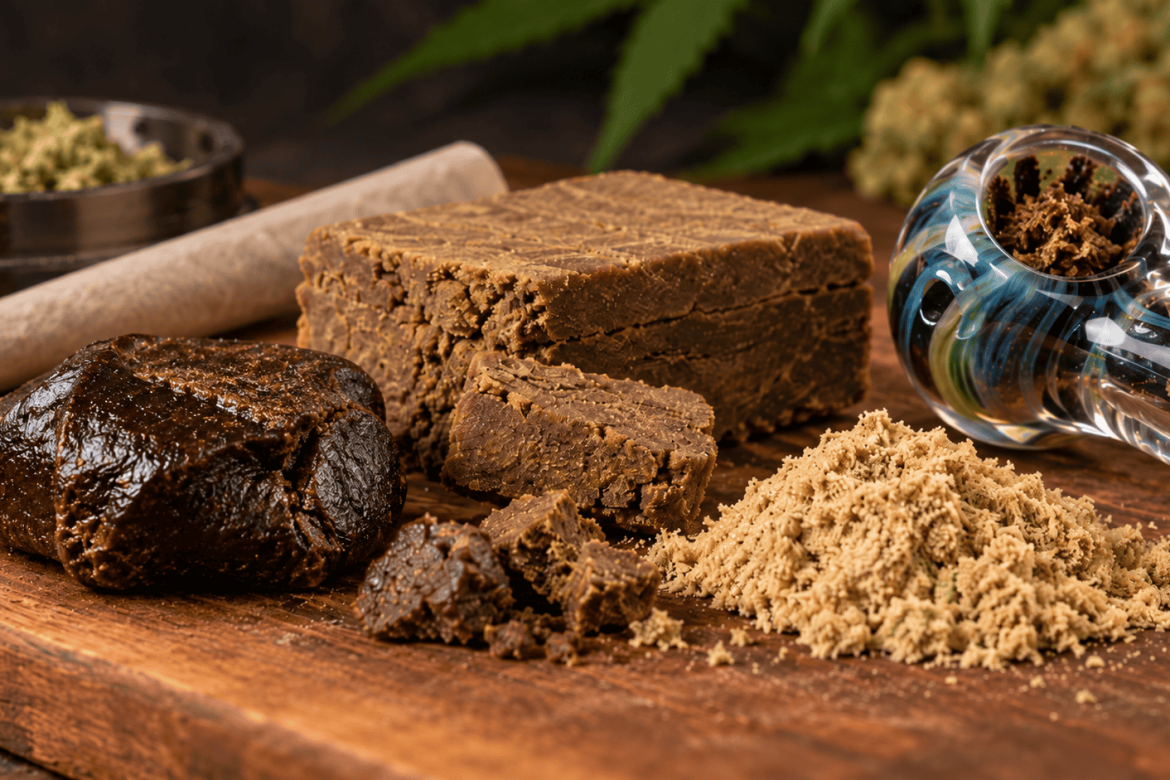
Good hash. Wrong method. Disappointing session. If your hash keeps going out, burns unevenly or ends up stuck at the bottom of a bowl, the problem may not be the hash. It may be how you are using it.
Soft, pliable hash handles differently from dry sift or brittle pressed slabs. The right approach starts with identifying the texture, choosing a suitable method, and avoiding more heat than you need. This guide covers joints, bowls, pipes, bongs and vaporizers—plus the science that helps explain the differences.
Want to compare styles while you read? Explore BWIBs hash collection . This guide stays focused on the technique, not product hype.
How to Smoke Hash: At a Glance
- Soft hash: Flatten it or roll it into a thin strand so heat can reach it evenly.
- Hard pressed hash: Gently break it into smaller crumbs rather than using a solid chunk.
- Dry sift and kief: Distribute it evenly and avoid spilling fine material into screens or air paths.
- Full-melt hash: Use equipment designed for concentrates if you want to preserve its character.
- Whatever the method: Start with a very small amount, go slowly and remember that inhaling smoke carries risks.
1. Start With the Hash: Texture Matters
Not all hash is the same. A soft hand-pressed ball, a brittle pressed slab and clean full-melt bubble hash may share a name, but they do not behave the same way under heat. Texture is a useful starting clue, not a laboratory test of type or quality .
| What it feels like | Likely style | Common approach |
|---|---|---|
| Soft, pliable, a little tacky | Hand-pressed hash | Thin strand in a joint, or flattened over a bowl |
| Hard, brittle, snaps apart | Pressed hash slab | Warm gently by hand and crumble |
| Dry and crumbly | Dry sift or kief -based hash | Distribute in a bowl or through a joint |
| Sandy or granular | Some bubble hash or dry sift | Use with a flower carrier unless its melt quality is established |
| Melts cleanly with minimal residue | High-grade full-melt hash | Compatible concentrate vaporizer or dab setup |
What about colour? Dark hash isn’t automatically better, and pale hash isn’t automatically cleaner. Colour alone cannot tell you potency, contaminants or melt quality. Bubble hash grades depend on how cleanly the resin melts, not simply how it looks.
Surface area helps explain the table. A thick lump heats from the outside inward, while smaller pieces expose more material to heat. That matters for evaporation, which depends on temperature, exposed surface and time. [5]
Related reading: For shopping considerations beyond texture, see our guide to choosing stronger hash in Canada . Appearance and a product name cannot establish lab-tested potency or purity.
2. Choose a Method That Fits Your Hash
There is no single method that suits every concentrate. For traditional pressed hash, bowls and joints are common options. For cleaner-melting varieties, vaporizing equipment made for concentrates may be a better fit.
How to Smoke Hash in a Bowl
The bowl is the forgiving classic. Instead of expecting a lump of resin to burn on its own, the flower underneath supplies a consistent ember. It also helps keep softened hash from slipping through an opening.
- Prepare a small, loose bowl of ground flower. Aim for a medium, even grind and avoid packing it so tightly that airflow is restricted.
- Break up the hash. Gently warm a hard piece between your fingers if needed and crumble it. Flatten soft hash rather than leaving it in one ball.
- Distribute it. Spread the material across the flower instead of piling it in one spot.
- Keep the heat controlled. Apply a brief flame to an edge of the flower rather than holding it directly against the hash.
- Draw normally and take it slowly. Concentrates can deliver more THC than the same-looking amount of flower.
If you’re using a pipe, glass or ceramic is preferable to improvised heat-exposed materials. Health Canada warns that some other materials may release harmful chemicals when heated. [6] And no matter what you’re using, smoking exposes the lungs to combustion products.
How to Smoke Hash in a Joint
The secret is distribution. A solid chunk of resin has poor airflow and may smoulder or burn unevenly. Keep the hash thin and let the flower do the work of maintaining an ember.
Method 1: The hash worm (for soft hash)
Soft, pliable hash can be worked into a narrow strand—often called a hash worm . Place it lengthwise among the ground flower before rolling, keeping it away from the very tip where the flame first hits. The point is an even distribution, not one large centrepiece.
Method 2: The crumble (for hard or dry hash)
Brittle pressed hash and dry sift are better broken into small pieces and mixed throughout the flower. Large chunks tend to heat irregularly; finer distribution makes the result more consistent.
In both cases, avoid overpacking the roll. Resin can restrict airflow, and a joint that is too tight will struggle to stay lit.
BulkWeedInBox tip: When comparing hash, pay attention to the texture description—not just the colour or name. Soft, pliable hash behaves differently in a joint from a dry, brittle slab. Product availability and characteristics can vary.
How to Vaporize Hash
For an example of how products describe this category, see Purple Punch Full Melt Hash . Check the product description and your device instructions before selecting a method.
Yes—if your device is designed for concentrates or officially supports a concentrate insert. Many dry-herb vaporizers are intended for flower alone. Putting sticky hash straight onto an ordinary herb screen may clog or damage the device, so follow the manufacturer’s instructions rather than improvising.
For compatible equipment, the general principles are straightforward:
- Use the approved insert or pad. It is there to keep melted material out of the air path.
- Avoid a thick lump. Distributing a small amount across the intended surface helps it heat consistently.
- Begin at the lower end of the device’s supported range. Increase gradually if the manufacturer permits it; the right setting is device- and material-dependent.
- Clean according to the manual. Hash residues can accumulate quickly.
Why bother with temperature control? A 2016 laboratory study using flower found that four electric vaporizers operated at 210 °C recovered between 54.6% and 82.7% of total THC into the vapour, with results differing by device. [2] That’s useful context, but it is not a measured recovery rate for hash .
A vaporizer may avoid burning the plant material directly, but it is not risk-free. Health Canada notes that vaping may reduce some lung risks compared with smoking while still exposing users to potentially harmful substances. [6] Cartridges are a different format, with different hardware and storage considerations.
Equipment note: Check the manufacturer’s compatibility guidance first. BulkWeedInBox accessories is a general collection, not a guarantee that any particular device supports loose hash.
Other Options: Pipes, Bongs and Hot Knives
These are familiar options, but there is less solid comparative research than the internet makes it sound like.
| Method | What to know | Biggest drawback |
|---|---|---|
| Hash pipe | Designed for resin rather than ordinary flower | Residue buildup and direct-flame exposure |
| Bong | Water can cool smoke and filter some substances; that does not make smoking safe [6] | Cooling can make harmful smoke feel less harsh |
| Hot knives | Traditional technique involving very hot metal | Burns, poorly controlled heat and little direct research |
Does a bong remove more tar than THC? That’s a popular claim with a shaky source. An often-cited 1996 newsletter experiment—which was not peer-reviewed —actually reported a worse tar-to-cannabinoid ratio for the waterpipes it tested than for an unfiltered joint. [3] Those results are not enough to rank every modern bong, but they’re enough to question the folklore.
Hot knives deserve the simplest caution: extremely hot exposed metal can cause serious burns. No peer-reviewed direct comparison was identified in the source research, so bold claims about their efficiency aren’t justified.
3. How Much Hash Should You Use?
Less than you think—and never assume two hashes have the same strength. The cannabinoid content of hash varies enormously by product, batch and preparation. Inhaled delivery also varies by device and smoking behaviour, so a universal quantity would suggest more precision than the evidence supports. [8]
If you are new to concentrates, begin with a very small amount, allow time to assess how you feel before using more, and do not combine it with alcohol or other intoxicants. Avoid deep inhalation or holding smoke in; Canadian-led lower-risk guidelines recommend avoiding combusted cannabis and risky inhalation practices. [12]
And don’t drive or operate machinery while impaired. If you feel unwell, stop consuming and move somewhere safe.
4. Why Heat and Temperature Matter
Heat does two jobs at once: it changes cannabinoids, and it can destroy them. THCA converts to THC when heated, a process called decarboxylation. But smoking temperatures also cause combustion and losses.
A review of simulated smoking experiments reported that THCA-to-THC conversion was nearly complete while only about 30% of THC was recovered in the studies it summarised. [1] Other experiments using flower show different delivery or recovery figures because they measure different things: smoke collected by a machine, vapour from a device, or THC reaching the bloodstream. Those figures should not be compared as if they describe one identical process. [7] [8]
Flame vs. vaporizer: why the difference matters
| Heat source | Research context | Control |
|---|---|---|
| Burning material | A study of tobacco cigarettes reported 800–900 °C in the burning cone during a puff; this is not a cannabis-joint measurement . [9] | No precise temperature dial |
| Electric vaporizer | Published cannabis-flower experiments often examine roughly 170–230 °C. [10] [11] | User-selected setting; actual material temperature varies by device |
The THC boiling-point myth
You may have seen charts claiming THC has a boiling point of 155–157 °C. A 2023 paper explains that this figure comes from reduced-pressure conditions, not ordinary atmospheric pressure. Under normal pressure, THC’s boiling point is much higher; vaporizers can still release cannabinoids at lower temperatures through evaporation over time . [5]
That means there is no magic setting that cleanly releases exactly one cannabinoid or terpene and leaves everything else behind. Temperature, time, airflow, device design and surface area all matter.
So what temperature is best?
There isn’t one universally proven setting for hash. One flower study found its lowest measured by-product-to-THC mass ratio at 230 °C, while another paper described combustion appearing near 230 °C and pointed to earlier work suggesting around 185 °C. [10] [11] Different devices, methods and definitions help explain why studies don’t agree.
Practical takeaway: use manufacturer-supported settings and avoid assuming the highest temperature is automatically better. These studies were conducted on flower, not on every grade of hash.
5. Can You Smoke Hash Without Tobacco?
No. Tobacco isn’t part of the chemistry of hash. Some traditions mix the two; others use cannabis flower instead. Adding tobacco introduces nicotine and its own health risks without being necessary to use hash.
A 2016 international survey of 33,687 respondents found strong regional differences in tobacco-based cannabis routes: 77.2–90.9% in the European countries sampled versus 4.4–16.0% in the Americas. [4] It was a self-selected online survey, so those numbers describe its respondents, not every cannabis user in each region.
For someone already choosing to smoke hash, flower can serve as a carrier without also introducing tobacco. That does not make inhaling smoke harmless.
6. Common Hash-Smoking Mistakes
Most problems aren’t mysterious. They’re texture, airflow or heat problems.
| Mistake | Why it causes trouble | Better approach |
|---|---|---|
| Using a big lump | Uneven heating and poor airflow | Distribute the material more evenly |
| Overpacking a joint | Resin and compressed flower restrict the draw | Keep the roll loose enough for airflow |
| Holding the flame on the hash | Direct combustion can destroy cannabinoids | Avoid prolonged direct flame |
| Putting sticky hash in an unsupported vape | Melted residue can foul screens or damage equipment | Use only manufacturer-approved inserts or devices |
| Assuming dark hash is stronger | Colour isn’t a reliable potency or purity test | Use labelling and verified product information where available |
| Taking several hits immediately | Concentrates may feel substantially stronger than expected | Start small and pause to assess effects |
| Holding smoke in | Unnecessary lung exposure; lower-risk guidance discourages it [12] | Inhale normally and exhale |
One point worth repeating: smoke is smoke. Lab research found substantial particulate emissions from cannabis joints, and Health Canada identifies smoking as a particularly harmful route of cannabis consumption. [13] [6]
7. Where Can You Smoke Hash in Canada?
There is no single Canada-wide rule for where you can consume it. Federal law regulates cannabis, while provinces, territories and municipalities add restrictions on public consumption, buildings and shared spaces. Rules also differ for rented homes and vehicles. [14]
| Province | General rule described in the source review |
|---|---|
| Ontario | Consumption is permitted in many outdoor public places, including some sidewalks and parks, subject to restrictions. |
| British Columbia | Generally follows restrictions on tobacco smoking, with limits in parks and other public areas. |
| Manitoba | Smoking and vaping cannabis in public places is prohibited. |
| Quebec | Public outdoor smoking is broadly prohibited, including on public roads. |
These summaries are based on laws and government material reviewed for the original draft in August 2026; they are not a complete list of exceptions. Check your province and local bylaws before consuming. This section is general information, not legal advice.
Frequently Asked Questions About Hash
Quick answers to the questions people ask most about hash, from joints and vaporizers to strength, safety and Canadian rules. Every answer is expanded below—nothing to click open.
How do you smoke hash for the first time?
Traditional hash is often smoked on a bowl of cannabis flower or mixed into a joint. The best approach depends on its texture: brittle hash breaks into small pieces, while softer varieties can be spread into a thin layer or strand so they heat more evenly.
Hash is concentrated resin, so its potency may be substantially higher than that of ordinary flower. If you choose to use it, start with a very small amount and give yourself time to understand the effects. There is no benefit to rushing the first session.
How do you put hash in a joint?
Two common approaches are the worm method for soft, pliable hash and the crumble method for firmer hash. In either case, the idea is even distribution rather than leaving one thick piece in the middle of the joint.
A large lump can restrict airflow, heat unevenly and cause the joint to go out. The texture of the hash matters much more than its colour or the name on the package.
Can you smoke hash without tobacco?
Yes. Tobacco is not required to smoke hash; it’s a regional preference rather than a technical necessity. Many people who use traditional hash choose cannabis flower as the material it is mixed with instead.
Skipping tobacco avoids the added nicotine exposure, but it does not remove the health risks of inhaling cannabis smoke. Combustion still produces harmful substances, regardless of what’s mixed with the hash.
Can you vaporize hash in a dry-herb vaporizer?
Some dry-herb vaporizers can handle hash, but not all of them. Check whether the manufacturer explicitly supports concentrates and whether the device has an appropriate insert or pad.
Sticky resin can melt into the chamber, clog screens or enter the air path of a flower-only device. Don’t assume a device is compatible just because it can reach a high temperature; follow the manufacturer’s instructions instead of improvising an insert.
What’s the best temperature for vaporizing hash?
There isn’t one scientifically established temperature that works best for every type of hash and every vaporizer. Studies using cannabis flower have investigated approximately 170–230°C, but results vary by device, study design and what researchers measured.
Those figures should not be treated as a proven hash-specific setting. Use a temperature range supported by your device manufacturer and remember that higher heat can increase the formation of unwanted by-products.
Why does hash keep going out in a joint?
Hash is dense resin, not a loose plant material that readily maintains an ember. When it sits in a thick lump, air can’t move through it easily, and the outside may heat while the centre remains relatively cool.
This is why texture and even distribution matter. A joint that burns unevenly is often a preparation problem rather than a sign that the hash is defective.
Is a bong safer for smoking hash?
Not necessarily. Water can cool smoke and filter some substances, which may make a draw feel smoother. But smoother smoke should not be confused with harmless smoke.
Health Canada warns that water filtration does not make smoking safe. The research behind sweeping claims that bongs dramatically improve cannabis-smoke filtration is limited, so it’s better to think of a bong as a different way to inhale smoke—not a safety solution.
Can you smoke full-melt bubble hash?
Full-melt bubble hash can be burned, but its defining quality is that it melts with little residue. For that reason, it is commonly associated with equipment specifically designed for concentrates rather than a conventional joint.
Not all bubble hash is full melt. Lower-melt grades may contain more plant material and behave quite differently when heated. Knowing the grade matters more than assuming every product labelled ‘bubble hash’ will perform the same way.
How much hash should you use?
There is no reliable universal amount. Hash potency differs by product, and the amount of THC actually delivered depends on the method, temperature and individual inhalation habits.
If you choose to consume, begin with a very small quantity, avoid combining it with alcohol or other intoxicants, and allow time to gauge the effect before considering more. A label’s THC percentage can help provide context, but it doesn’t tell you exactly how much you’ll absorb.
Where is it legal to smoke hash in Canada?
Canada’s federal cannabis framework does not create a single national rule for every place you can smoke. Provinces, territories, municipalities, landlords and property owners may impose different restrictions.
For example, some provinces permit consumption in certain outdoor public spaces, while others prohibit smoking cannabis in most public locations. Check the current rules for your province and municipality, and remember that restrictions around vehicles, workplaces and shared buildings may also apply.
Final Thoughts
Soft hash likes a thin strand. Hard hash likes to be crumbled. Sandy hash needs careful handling. Full melt belongs with compatible equipment. Beyond that, the main principles are consistent: use less, avoid unnecessary heat, and don’t confuse a smoother inhale with a safer one.
Know what you have before choosing how to use it. For BulkWeedInBox readers comparing traditional hash styles, texture and product details are a more useful starting point than colour alone.
Keep Exploring on BulkWeedInBox
Want to compare traditional styles with newer extracts? Browse hash varieties , discover other cannabis concentrates , or read our beginner’s guide to shatter to understand how its handling differs from pressed hash.
Leave a comment